
Please Understand Me

You could tell some people that the sky is blue, and they would drag you into a three-hour debate about how it’s purple. We know this. We know, intellectually, that some people are committed to misinterpreting every syllable that leaves our mouths.
Someone asks you a very simple question, like, “Hey, can you help me move this Saturday?” or “Did you get a chance to look at that draft?”, and instead of just giving an answer, your brain immediately starts building a court case.
You don’t just say, “I can’t make it this weekend.” Instead, you breathe in and say, “Oh, I wish I could, but my week has been so completely backward, and my tire has this weird slow leak I have to get checked, and honestly I’m just so burnt out from this project at work, but if it were any other Saturday you know I’d be there, please don’t hate me…”
You answer the question in the first sentence. The next seven are an attempt to prevent disappointment before it happens… and by the time you’ve finished explaining, you’ve apologized for existing.
If you do this, you know how extremely exhausting it is.
We don’t do it because we love the sound of our own voice. We do it because we are terrified of what will happen if we stop talking.
The Fear of Being Rewritten
Let’s drop the elegant excuses, and sit in the uncomfortable truth. We like to call over-explaining “being thorough” or “valuing clarity.” But if we look at this pattern with full emotional intelligence, it’s a defense mechanism.
You’re not actually trying to help the other person understand your day. You’re trying to manage the thoughts inside their head before they even have them.
You are anticipating where they might get hurt, where they might judge you, or where they might decide you are a bad friend, a lazy worker, or a selfish partner.
Every extra sentence is a layer of bubble wrap you are desperately wrapping around your “No” because you think the truth on its own is too sharp.

You are screaming between the lines: “Please see that my intentions are good. Please don’t write me into your story as the villain.”
The strange thing is, most of us are fighting to protect an identity.
Somewhere deep down, we believe they’ll get us wrong. That one incomplete conversation will become who we are in their mind.
So we keep talking, hoping that if we add one more sentence, one more disclaimer, one more piece of context, we can rescue ourselves from becoming someone we know we’re not.
And usually, this habit is born from experience. When you grow up in an environment where people weaponized your silence, read between lines that weren’t there, or pulled away the moment you weren’t perfectly convenient for them.
It’s the muscle memory of a person who has had to defend their heart to a jury that had already decided they were guilty.
The Two Sides of the Same Anxiety
We run this pattern in two completely opposite directions, but the engine driving both is exactly the same.
1. The Over-Explained Boundary
When we have to set a limit, we treat it like a crime we are committing against the other person. The over-explanation is our plea deal.
We think if we throw enough context and visible exhaustion at them, they’ll judge us “not guilty” for having a human boundary.
But the irony is that by giving people five reasons why you can’t do something, you give them five handles to pull on. You invite them to negotiate your life. If you say, “I can’t come because my car is acting up,” they say, “Oh, I can pick you up!”
Suddenly, your boundary is gone, because you based it on a circumstance instead of your right to just say no.
2. The Over-Explained Excuse
This happens when we genuinely mess up, miss a deadline, or have to drop the ball. A grounded interaction is simple: “I messed up and missed this deadline. I’m really sorry. I’ll have it to you by tonight.”
But for an over-explainer, a mistake feels like a character flaw. So the excuse becomes a multi-part documentary. You walk them through the glitches… the family emergency, the emotional weather of your week.
You are begging them to still see you as good, not just apologizing for the mistake.
The Only Explanation You Actually Owe
Whether it’s a boundary or an excuse, the confession at the core of the over-explainer’s heart is this:
“I don’t trust that I am allowed to just exist with limitations.”
We over-explain because we believe that the love and respect we receive are conditional, based on our perfection or our constant availability. We think that if we leave a silence, they will fill it with disapproval.
But here’s the perspective shift that changes everything:
The people who actually love you don’t need a brief. They don’t need you to prove your exhaustion to validate your “no,” and they don’t need a documentary to forgive your mistakes. They just trust your heart.
And the people who do demand a brief? The ones who pick apart your reasons and demand a higher tax of explanation? They usually aren’t listening anyway. They’re just waiting for you to finish talking so they can tell you why your reasons aren’t good enough.
Healthy relationships can survive incomplete explanations.
The Cold Silence of Letting Them Be Wrong
Maturity is allowing someone to think badly of you and doing absolutely nothing to correct it.
We over-explain because we cannot tolerate being misunderstood. We’re chasing relief, not clarity.
It feels like physical illness to let a text chain end on a misunderstanding. Your thumbs itch to type. Your chest burns to clarify. You want to scream, “No, that’s not what I meant!”
But what if you just... didn’t?
What if you closed the app, put the phone face down, and let them sit with whatever fictional version of you they’ve constructed in their head?
What if you realized that your character isn’t something you need to constantly justify?
We spend so much of our lives trying to correct stories that were never written in good faith.
Why is the fiction in their head more important than the truth in your bones?
How much of your life are you going to keep burning away just to prove to an audience that doesn’t care, that you deserve to occupy the room you’re standing in?
Stop trying to proofread your life for people who are committed to misreading you.
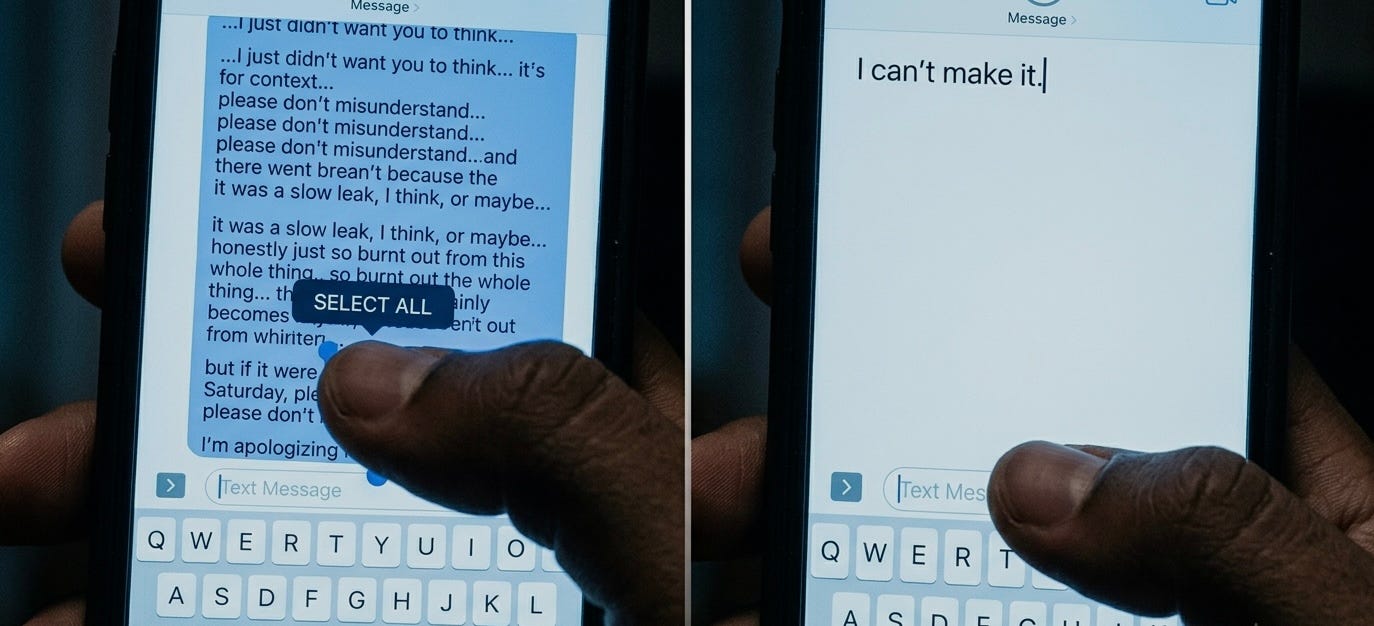
Say the simple sentence.
Let it sit on the page.
The right people will understand it just fine.
This essay is Part 1 of Identity Fraud, a weekly series exploring the identities we perform before we discover ourselves.
If this piece made you want to immediately delete a three-paragraph draft message, you’re exactly where you belong.
If you know someone who’s still acting as an unpaid defense attorney in their own head, send this their way.
Quit the job. Part 2 drops next week.
With love,
Becky
