
The Trophy of Regret

There’s a drawing somewhere from when I was small. Unsteady lines, colours outside the edges, proportions completely off. I can see every mistake now, not because the drawing is bad, but because my eyes learned things since then.
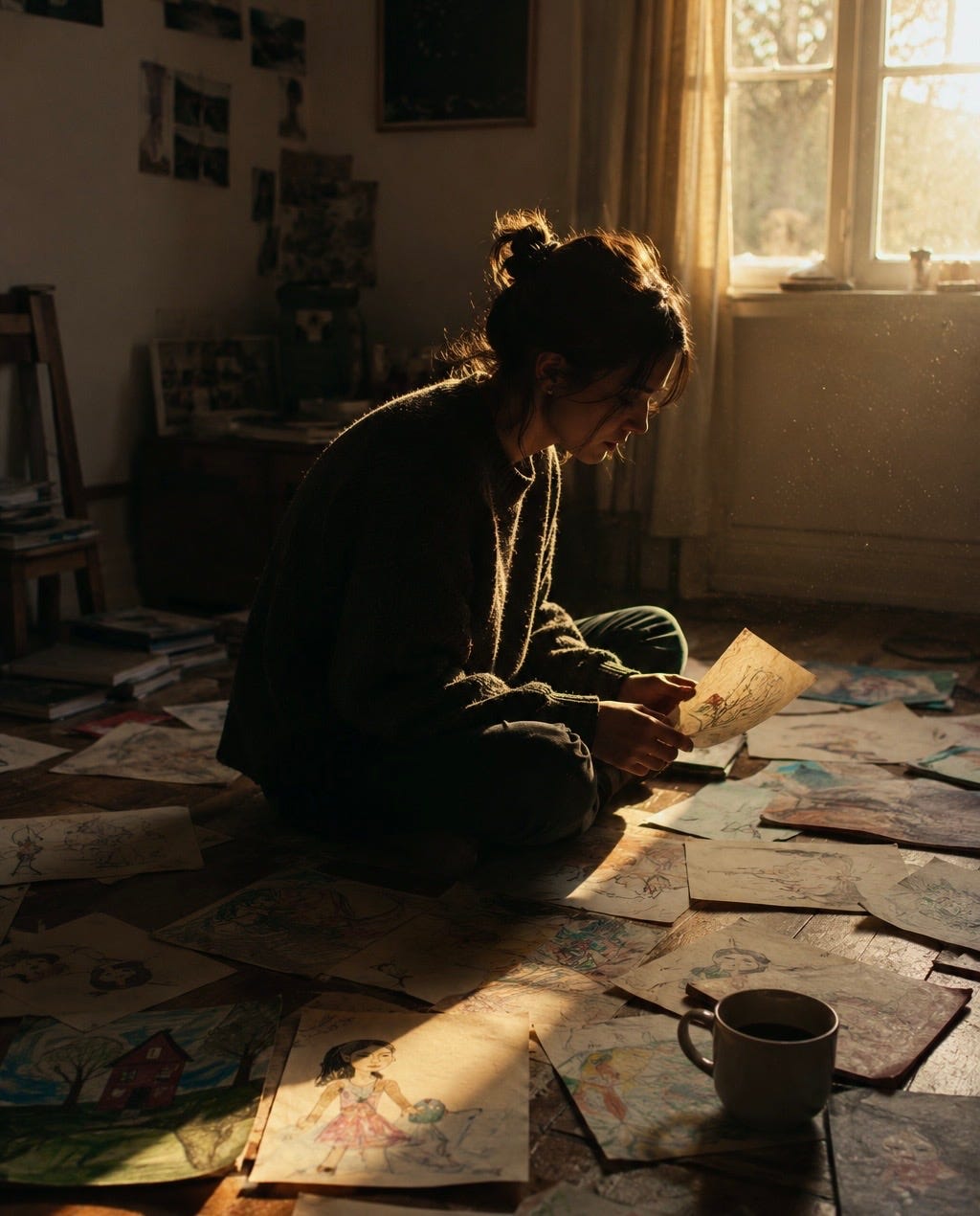
That’s what regret is.
We were taught to call it shame. To perform our way past it, no regrets on t-shirts, tattoos, graduation speeches. Posted under pictures of people who look like they have never once questioned a decision they’ve made. We treat it as the hallmark of a life well-lived.
It sounds like freedom, but it’s actually a very elegant way of refusing to grow.
Regret has been misdiagnosed. It is not a character flaw or evidence of failure, it is the distance between who you were then and who you are now, made visible. That distance is called growth. And most people are walking around ashamed of the very proof of it.
The child who made that drawing wasn’t failing. Just doing exactly what a 5year old with a crayon and a piece of paper can do. You don’t owe that version of you contempt for the limitations that hadn’t yet been grown past.
Your past choices work the same way. Made with everything you had at the time. Imperfect not because you were careless, but because you were still learning, the way every human being who has ever lived has been still learning until they weren’t.
The ability to see the mistakes now means your eyes got better. That is the only thing it means.
The person who insists they would do everything exactly the same way again has not made peace with their past. They have made a truce with it. An uneasy, effortful truce that requires keeping their eyes forward at all times so they never have to reckon with the view behind them.
Because the moment they admit they would choose differently now, they would also have to admit they were wrong then.
And for some people, that feels unbearable. Not because they lack integrity, but because they mistake regret for self-condemnation.
So they defend every choice, every mistake, every version of themselves as if acknowledging growth would somehow invalidate the person they used to be.
It doesn’t. It simply means their eyes got better.
Real peace looks like being able to say I would do that differently now, and meaning it without crumbling. Holding what happened with enough steadiness to be honest about it, and understand it clearly enough that you don’t repeat it.

Regret, looked at honestly, is one of the most useful tools you have. Regret, performed away, is just unprocessed experience waiting for a different disguise.
The work, and it is work, is learning to hold two things simultaneously about your past self.
Honesty and kindness. Not honesty then kindness, as if you have to earn the softness by first being hard on yourself. Both at once.
“I would do that differently now.” That’s the honesty.
“But that version of me didn’t know what I know now.” That’s the kindness.
The goal isn’t to erase regret. It’s to learn from it without turning it into shame.
One without the other becomes either self-deception or self-punishment, and neither of those is growth.
Regret is not a weight to carry. It’s orientation, a compass pointing toward the version of yourself still being built.
When you feel it, something in you is saying: I know better now. That knowing is not an accusation against who you were. It’s an invitation toward who you’re becoming.
The question regret is really asking isn’t why did you do that, it’s “what will you do with what you now understand?”
That question, answered honestly, is the whole project of becoming a person.
So keep your regrets. Not to drown in them.
Keep them the way you keep an old drawing, as evidence of distance traveled. Proof that between then and now, your eyes got better, your hand got steadier, your understanding of the whole picture grew.
What would you do differently now, and what does that tell you about how far you’ve come?
With love,
Becky
